Monday, March 22, 2010

Science Verse

Science Verse
by Jon Scieszka
and
Lane Smith

This children's literature is a picture book with an interesting take on science. While in class a boy is zapped with the curse of Science Verse. From that moment on in science the boy begins hearing everything as a science poem. Each subject uses a famous poem or song to tell a sarcastic view as a student may see it. For example Edgar Allen Poe's poem "The Raven" is turned into "Dino-Sore" to tell about what it feels like to learn about dinosaurs in a rather boring science classroom. The illustrations in this picture book are so bold and especially creative. This version of the book includes a CD with the book read by Scieszka and Smith which adds a a whole new level because it shows readers how the authors intended the book to be read. Some of the topics included may be more appropriate for the older grades. Over all I really enjoyed the amount of creativity that went into this book and I think children will enjoy how it is rather outside of the box.


Intended Age 9-11

Reflection

_______________________Reflection________________________
Reading and Responding to Children's Literature has been a great class so far. I am very pleased two things in particular. First of all, I cannot believe how many wonderful books the class is introducing me to. I already have a lot of great titles and authors that I plan to bring into my own future classroom. I believe that it is extremely important for students to see that the teacher has a connection to the book that is being read aloud in class. Not only does this allow for the teacher to be more prepared to use the children's literature in class, but it shows students that the teacher enjoys the book and reads books too. The two novels that we have read so far in this class The Misfits and The Giver are such wonderful reads that I wish I had been introduced when I was in elementary school. The second thing I have really enjoyed from this class is the glog that we are beginning. So far the things that we have done in class are very practical that I can and will carry into my classroom such as this glog. I was excited to learn that we were going to be making a handout as a tool to interest students into a particular book, but I was even more excited that we would be trying a way that would actually stand out for the tech savvy kids today. This is a tool that seems wonderful because it does incorporate multiple forms a media to draw students attention. All in all this class is going wonderfully. Even if I did not have the practical content to take away, our classroom discussions have taught me another powerful idea: do not be afraid of one parent. Coming into this class I continue to shy away from lessons or content that may offend someone, but this class has defiantly taught me otherwise. Chances are something I will teach may offend someone at sometime, but that should not scare me away from teaching all the children wonderful books or lessons that they can truly benefit from such as The Misfits, The Lorax, or And Tango Makes Three.

The Frog Prince Continued

The Frog Prince Continued
by Jon Scieszka
paintings by Steve Johnson

So I thought that I knew the story of the Frog Prince where the princess kissed the frog and he turned into a handsome prince and so they lived happily ever after; but this children's book suggests that I am wrong. This hilarious story continues the fable of the Frog Prince by telling the story of what happened after the Prince and Princess lived together. Both get on each other's nerves and so the story goes on to tell how the Frog Prince tries to find a witch that will turn him back into a frog so he really can live happily ever after. The witches he runs into are the witches from other common fairly tales such as Cinderella, Hansel and Gretel, and Sleeping Beauty. Children will enjoy reading this different take on many common fables, but with most of Scieszka's children's books, children will enjoy them more if they are familiar with the original fairy tales first. Steve Johnson's illustrations are wonderful because they are so dark and dramatic they really make the images pop out. Even the biographies in the back flap of the book are sarcastic and funny to continue the theme developed throughout the great book.


Intended Age 3-5

The Stinky Cheese Man and Other Fairly Stupid Tales

The Stinky Cheese Man and Other Fairly Stupid Tales
by Jon Scieszka
and
Lane Smith

This children's picture book takes a spin at common fairy tales such as Chicken Little, The Little Red Hen, and Jack and the Bean Stock; but adds a very sarcastic spin. Rather than simply writing another version of The Tortoise and the Hare, Jon Scieszka and Lane Smith turn it into The Tortoise and the Hair and tell the story of the slow turtle trying to race a rabbit growing out his hair. These silly twists on fables end up being hilarious and are sure to draw children's attention. I loved the bold and dramatic illustrations done throughout the whole book. One of my favorite illustrations comes in with the story of the Little Red Hen. On one side of the book is a completely blank page with the other side showing the hen complaining "I planted the wheat. I watered the wheat. I harvested the wheat. Now do I get to tell my story?" She continues on to suggest that the illustrator is just as lazy as the dog, cat, and mouse as known from the true story of The Little Red Hen. The hen even makes another appearance at the end as she is intertwined with the other fairly tales from the story. Children would benefit the most from this book if they have already read the more common versions of these popular fables because they would understand more of the puns. The layout of this book is very honest and sarcastic too with the title page reading Title Page, and the dedication page upside with a blurb saying "I know. I know. The page is upside down. I meant to do that. Who ever looks at the dedication stuff anyhow?" All in all, I loved this book and I think that many children will get a laugh out of it too.


Intended Age 5+

Sunday, March 7, 2010

The Misfits

The Misfits
by James Howe

The Misfits is an amazing novel about a perfectly random group of four students: an overweight tie salesman, an early activist, a young homosexual, and a sloppy hooligan. These four twelve year kids form "the misfits" because they believe they do not fit in with the others in the small town of Paintbrush Falls. Beginning with Addie the activist's refusal to say the Pledge of Allegiance, the group (Addie) decides to form a new political party at school to run for student council. The group frequently bonds together at the Candy Kitchen to discuss the happenings of seventh including popularity, love, politics, and the meaning of misfits. This wonderful novel continues as each member of the group begins to discover who they truly are.

This book is told from the perspective of Bobby as he divulges his true feelings to the reader. Using one of the main characters as a narrator is an interesting way of writing a book that I have not seen very often and can bring a lot to children's literature. Between this type of narration and the combination of James Howe's hilarious and unique writing style this book is sure to have the readers laughing out loud. This book carries a great message as the No-Name parties slogan suggests: Sticks and stones may break our bones, but words will break our spirit. The group pushes to end all name calling. I believe that so many readers would be able to relate to this because they have either probably been called a name, name called, or at least seen it happen. After reading this book it allows people to think about how even the subtle name calling can cause so much pain to people.
This book has caused some controversy because one of the main characters is gay and this novel tells his story about some of the difficulties he goes through as he crushes on his classmate Colin. I believe this book should be embraced in schools because Howe treats Joe's sexuality just as he does with the other main characters. Joe is not pushed out into his own book like homosexuality is often dealt with in children's picture books. This book deals with a lot of other topics including politics, gender, bulling, and race which could make for wonderful discussion during a classroom discussion. I thoroughly enjoyed this fresh, fun, and enlightening book written with a personality by James Howe. I definitely intend on bringing The Misfits into my future elementary classroom.


Intended Age 9-12

Tuesday, March 2, 2010

Sylvester and the Magic Pebble

Sylvester and the Magic Pebble
by William Steig

This is a tale of Sylvester the donkey as he comes upon a magic pebble. In a moment of fright, Sylvester asks the magic pebble to turn him into a rock. Sylvester is then unable to turn himself back into his old self and remains a stone. The rest of the story goes about how the community tries to find where Sylvester went. In the course of this, his family goes to the police for help. This part of the story has placed this book under fire because Steig portrays the policemen as pigs. This ultimately caused this Caldecott Medal winning book to be banned in parts of the United States. This seems outrageous that this good book would be banned for such a minuscule and unimportant detail. All of these characters are portrayed as animals and the police were chosen as pigs. No text within this story suggests that meaning was put into the animal character choice. All in all, I enjoyed reading this cheerful book and intend on having it be part of my future elementary classroom.


Intended Age 4-8

Monday, March 1, 2010

The Five Chinese Brothers

The Five Chinese Brothers
by Claire Huchet Bishop
and
Kurt Wiese

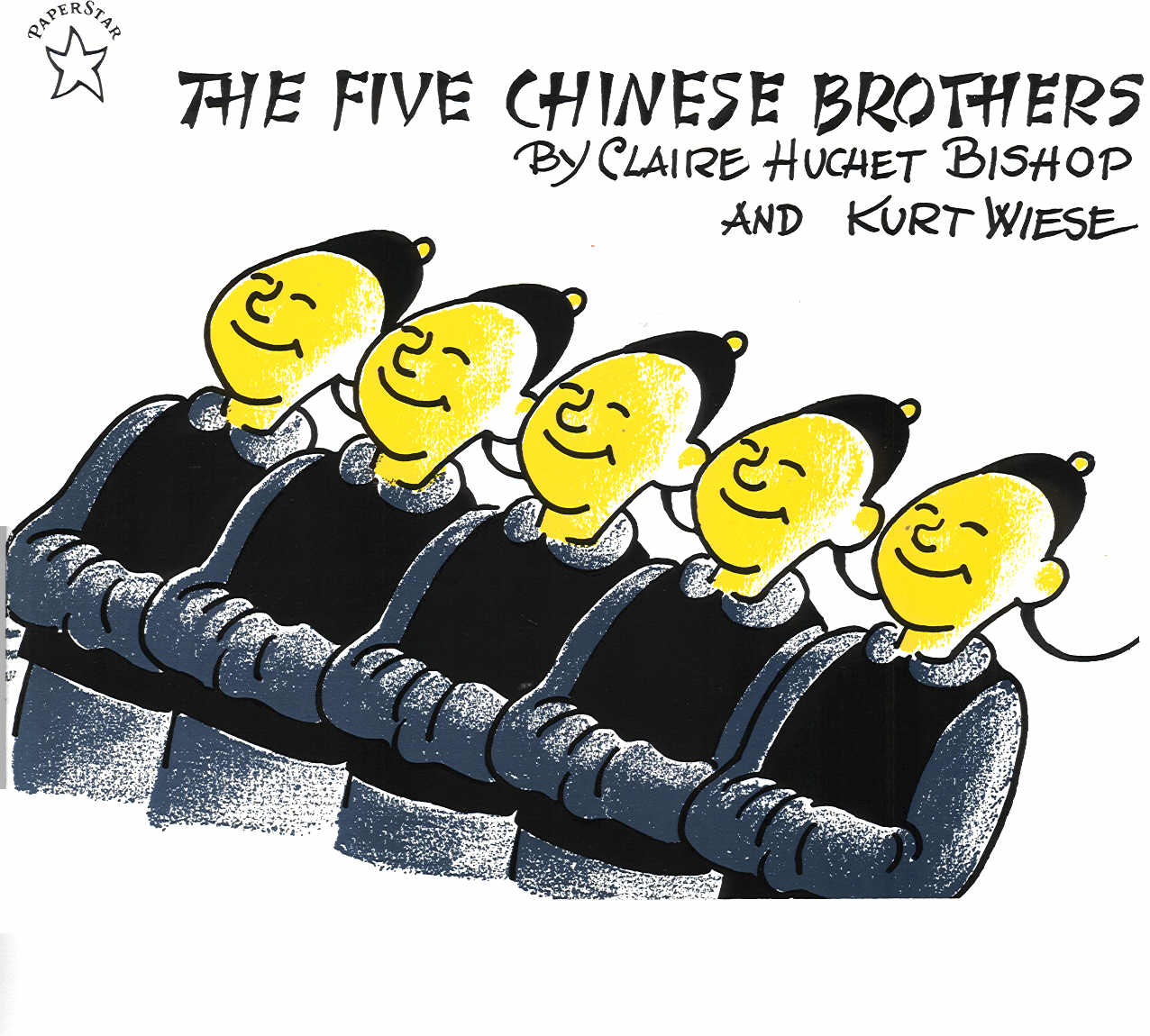
This children's picture book is the retelling of a Chinese folktale about five Chinese brothers that look exactly the same but each brother has his own superhuman power. The First Chinese Brother could swallow the sea and in doing so he was accused of drowning a boy and was condemned to have his head cut off. The Second Chinese Brother comes back in his place because he has an iron neck so the judge is unable to cut his neck off. The story goes on as the judge tries to drown him, burn him, and smother him all while the identical Chinese brothers switch places so none of them die. The Five Chinese Brothers has been placed on many controversial book lists because some people believe this book is racist due to the fact that the five Chinese brothers all look identical. There is also criticism because the illustrations draw the Chinese men's skin with a yellow hue and with slit and slanted eyes. The drawings in this book can be seen as stereotypical, but I find them to take on the common cartoon-like look that is often seen in folktales and fairy tales. This story is about five identical Chinese brothers, but what is to say that they are not quintuplets that are identical. Why must we look for the bad and assume it is because of their race that they look identical. I believe it would be more important to bring this into the classroom to see another culture's folktale, rather than ban this book because some think it may be stereotypical. If all books were nit picked this much we probably would only have one type of book that fit a mold so tight that hid so many things picture books can teach us. If books are edited so much we may not have many folktales because they are too harsh, violent, or racist in some way. I think books such as this one are fine in the classrooms if they are prefaced with the right conversations.


Intended Age 4-8