Wednesday, January 27, 2010

Dracula Doesn't Drink Lemonande


Dracula Doesn't Drink Lemonade
by Debbie Dadey
and
Marcia Thornton Jones


This children's novel is part of The Adventures of the Bailey School Kids series. I personally grew up ready many of these mystery novels throughout elementary school. Each book in the series follows a similar format where the four main characters suspect someone of being a monster. In this particular book, the third-graders suspect the new counselor of being Count Dracula. While Dadey and Thornton Jones carry the same four characters throughout the series, there is no character development but the readers can continue to know and count on a similar plot line. The titles of these books are goofy, fun, and intriguing. These novels also include drawings of the scene every couple of pages. These drawings could possibly give too much of the story away and hinder the imagination of some readers, while for others it may be a helpful way to depict the monsters in each book.

Intended Age 7-10

Tuesday, January 26, 2010

Actual Size

Actual Size

by Steve Jenkins


This picture book goes through a wide array of animals and shows the actual size of specific features of the animal. It is extremely interesting because it actually makes sense of facts and figures by illustrating what they look like. Many readers will be amused be the wacky facts such as a Goliath birdeater tarantual is 12 inches across when Jenkins makes the fact tangible by illustring it. The images are also really creative and neat because they are made from cut and torn paper and can even be noticed when some letters of a torn paper are left showing. Jenkins also includes important skills such as comparing in his book. For example, on on page there is a replica of a gorilla's massive hand and the opposite side depicts a pygmy mouse lemur holding it's hand out to show the idea that both still have hands a lot like humans. Another great feature to this book is at the end where it gives many more detaila about each animal included in the book. Overall a very fun, stunning, and dramatic way to make facts come alive.


Intended Age 4-8

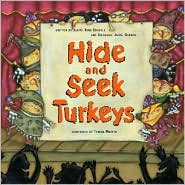
Hide-and-Seek Turkeys

Hide-and-Seek Turkeys
by Judith Ross Enderle
and
Stephanie Jacob Gordon
illustrated by Teresa Murfin

Entertaining is how I would best describe this fun picture book. Hide-and-Seek Turkeys is about a group of children perform a play about ten turkeys trying to hide from a fox. Readers can look close at the bold, colorful, and fun illustrations to really see the set and background stage that they put together throughout every page of the book. This book become interactive when each picture describes in detail what the text is saying. The story also helps the young reader practice with counting not only through the context of the story changing and adding a turkey each time, but also through allowing the reader to count the number of turkeys in each illustration. Another unique feature is that the vocabulary is almost all rather common and simple except for the idea that most pages introduces one additional word. This is a great concept because the young reader will know the majority of the context except for the one new vocabulary word. Also each new word fits into a new colonial clothing group such as tricorn hat, britches, and pantaloons. Each picture is also focused around the new word to help readers get a brief sense of what the word is. This book would work well as an book to be read as part of a primary grade colonial times mini-unit.


Intended Age 4-8

The Cow Who Clucked

The Cow Who Clucked
by Denise Fleming

This is a picture book for beginning readers about a cow who loses her moo. Cow goes all around the farm to search to see if another animal has her moo. This book is a typical animal book that teaches children sounds and common animals make. One up side is the illustrations throughout the book that are unique, colorful, and fun. The pictures also have other things in the background that help set the scene and build the book. This book has another neat feature because Cow's face is not always showing but the reader would still be able to infer what emotions are being portrayed through the background and text.


Intended Age 4-7

Monday, January 25, 2010

Hosie's Zoo

Hosie's Zoo
pictures by Leonard Baskin
words by Tobias, Hosea, Lucretia, and Lisa Baskin

This picture book goes through the world of animals using large watercolored pictures and poetic words. The pictures depict each animal with a close up of the face to really understand each and every animal. Each page also has a poetic description of the animal that will keep any reader entertained because the poems are of many different formats; some free verse and some rhyming. Young children will enjoy looking at the pictures but may have a difficult time understand some of the large descriptive words, while older readers will enjoy the effort of the written expressive poems.


Intended Age: All Ages

The Chicken of the Family

The Chicken of the Family
by Mary Amato
illustrated by Delphine Durand

This fun story tells about young Henrietta whose two older sisters tease her into believing that she is actually a chicken. Young readers may find this story very relatable if they have any older siblings that pick on them and will learn important and helpful ways to understand how to deal with that situation. This picture book has a happy ending when Henrietta pretends to be a chicken and learns to love her differences. The illustrations are lively and fun and often include many fun details in the background of the pages. Young readers will learn to feel comfortable in their own shoes and realize that giving in and copying others is not always the best answer. There are a fair amount of words for each page, but there are many common small words that a young reader should not feel too intimidated.


Intended Age 4+

I, Doko

I, Doko
by Ed Young

This picture book is the tale of a Nepalese basket as it lives and tells about its use through three generations of its family. The book creates an interesting tale because it is told from the perspective of the basket which allows for it to survive the death of the first family and proceed on living to tell the rest of the story. The diversity it brings to the reader is wonderful as it describes a tradition in a culture. The reader is allowed to relate through the descriptions to find similarities and may also find differences throughout the tale. The story focuses around the harsh treatment of elders and teaches the reader respect, tolerance, and harmony. The illustrations focus on great detail where it is needed such as the emotion that is trying to be convey also through the text. The choice of gold edging on each page adds another touch to richness of the book.


Intended Age 4 +